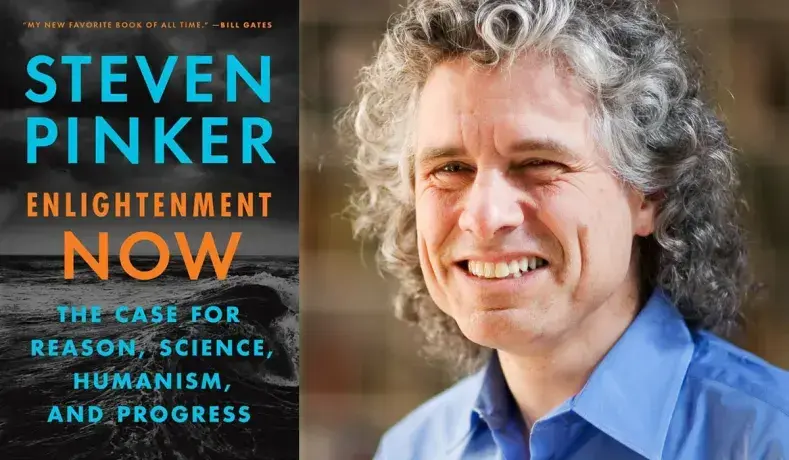
This is Part II of a series of blog posts on Steven Pinker and his book Enlightenment Now: The Case for Reason, Science, Humanism, and Progress. Read: Part I, Part III, Part IV
Steven Pinker argues that as people get smarter, they are less religious. Apparently, he has not heard of JRR Tolkien, CS Lewis or John Lennox—none of whom are cited. In the context of science, he doesn’t cite Alistair McGrath or Francis Collins. His snide approach doesn’t suit his credentials, but it is presumably a function of the US culture wars—where those on both sides exchange fire with acerbic abandon.
Pinker argues that humanists are engaged in a heroic struggle against the forces of darkness. He argues that the Enlightenment has worked [8]. His sense of meaning comes from the cause of progressive humanism. He proposes that humanism, born of the Enlightenment, is winning--it's not.
The foundations of humanism are not convincing. For example, what about ethics? Pinker's ethics, as they are not from an external divine source, are a form of self-service consensus. We’ll all just try to get along. The problem: it doesn't work. The powerful often don’t agree and end up exploiting the situation. Look at the collection of world leaders—are they doing what is best for everyone? Pinker is naive. Why not “serenity now” and “Festivus for the rest of us?”
Regarding the role of Christianity in Western Civilization, he sees none. This contrasts with Tom Holland’s Dominion: How The Christian Revolution Remade the World, which underscores the critical role of Christianity in forming the bedrock of Western civilization. There is Niall Ferguson’s Civilization: The West and the Rest, which details the role of faith. Further, there is Jordan Peterson’s We Who Wrestle with God and other writings that put the biblical narrative at the centre of Western civilization.
Pinker focuses on the primacy of reason and discounts the fact that your brain may be an emotional trigger directing your thoughts. People who aren't stupid disagree. Ian McGilchrist in The Master and His Emissary: The Divided Brain and the Making of the Western World argues that the brain's two hemispheres have different, complementary roles. The right hemisphere (the "Master") provides broad context, meaning, and attention. The left hemisphere (the "Emissary") focuses on specific details, tools, and abstraction, leading to different "worlds" or realities. McGilchrist's perspective is that Western culture, particularly since the Enlightenment, has suffered from the Emissary (left brain) becoming dominant, usurping the Master (right brain) and leading to a fragmented, utilitarian, and unbalanced view of the world that diminishes human experience, creativity, and connection to reality, despite the left's usefulness in specialized tasks.
Despite Pinker being among the intelligent, he has a number of howlers in his book.. First, humanists abolished slavery. I guess he’s never heard of William Wilberforce—also not cited anywhere. Second, he says Hitler was a Deist and provides a quote from Hitler that he is "doing the Lord's work." [430] He implies that Hitler was motivated by Christian ideals. I think that it’s safe to say that Hitler was closer to being a humanist. Third, a high suicide rate in a society is not a measure of broader unhappiness. Rather, suicides rise because people are so happy that those who are less happy can’t take it any longer.
It seems important to his argument that faith is declining, and religion is losing, and that humanists are winning (other than "the revenge of the cradle" in some societies). Pinker fails to distinguish between religion (in terms of formal structures) and spirituality (unorganized expressions of religiousity) in his analysis. In fact, spirituality has been growing, which has been amply demonstrated. One example is Rodney Starks' The Triumph of Faith: Why the World is More Religious Than Ever.
The Emissary (left brain), reflected by Pinker, continues to denigrate the Master (right brain). Here is a source of Pinker’s humanist angst: “And here is a shocker: The world has made spectacular progress in every single measure of human well-being. Here is a second shocker: Almost no one knows about it.” [52] If only people were smarter, they would agree with Pinker.