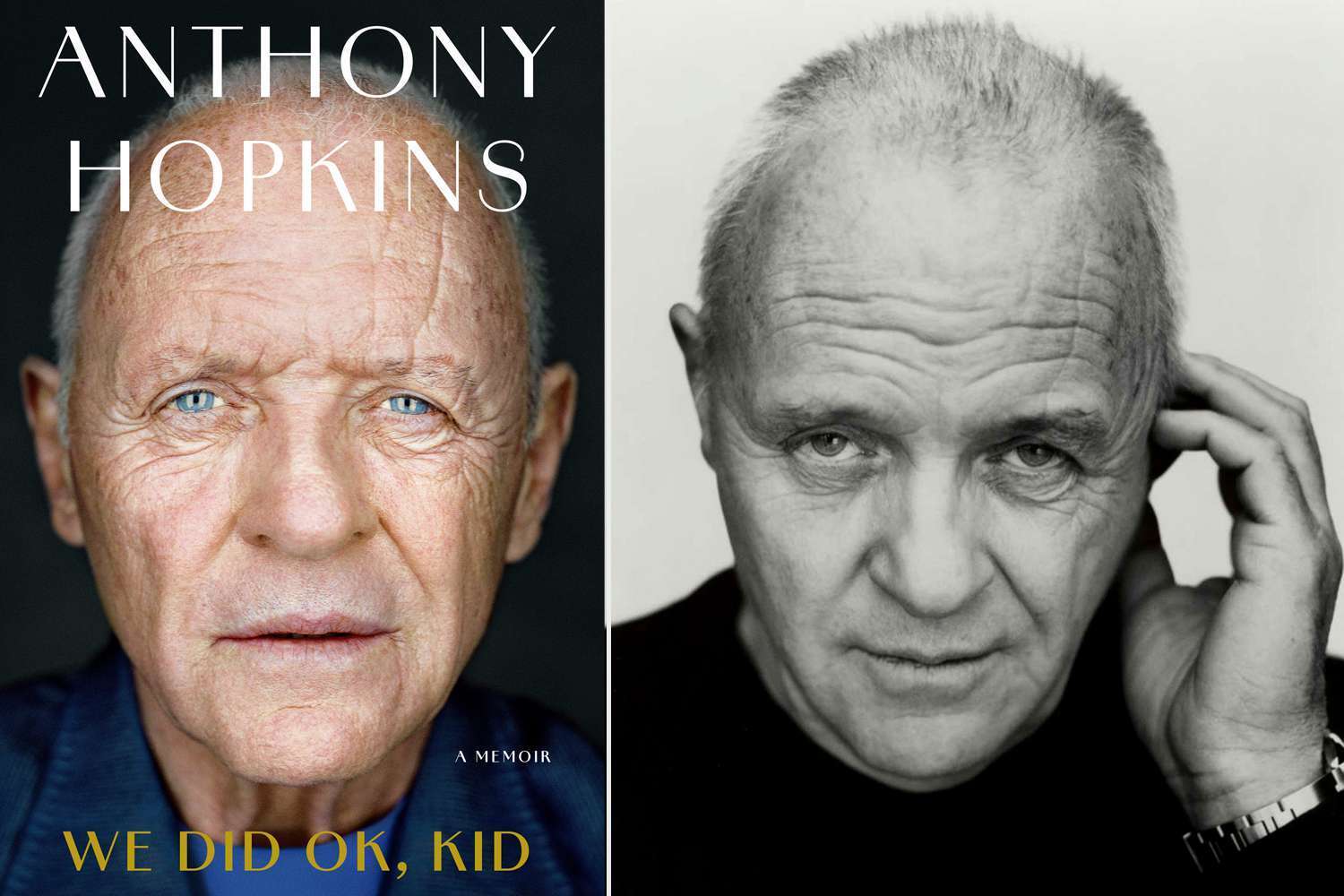
What can we learn from the nine-decade life story of one of the most accomplished actors of this generation? Anthony Hopkins has recently published Anthony Hopkins: We did OK, Kid. There are many great stories and tales of his interactions with famous actors. At the same time, he offers many reflections on the meaning of life, which is the focus of this blog post.
A Candid Self-Reflection
Anthony Hopkins is a case study in the contradictions and shallowness of an atheistic approach to life. He doesn’t offer—in more than 300 pages—a coherent view of meaning but a series of disjointed musings.
He paints his life in unflattering terms: he is a loner, anti-social, irascible, a long-time difficult drunk, unlikeable, a trail of ruined relationships, a cause of two divorces, a father who walked out on his infant daughter, and haunted by demons. As a child, he was branded as stupid and incapable of learning. He reflects on his childhood, rejection, bad choices, and bad experiences.
Throughout the book, he covers faith, meaning, death, and eternity. The book is interesting and gripping, but not deeply insightful.
Christian Cultural Backdrop
Exposure to Christianity is part of his cultural context, but not as a source of answers to life's big questions. He recounts that when he recited the Lord’s Prayer as a youngster, “My father scoffed: 'Don’t believe in that rubbish. That’s fairy tale nonsense.” [34] Yet, later in the book, he talks about hearing voices, a spectral communication from his deceased father, and praying to a god whom he didn’t believe existed.
Why did his father take that approach? “That’s the way he was constructed. He, like his father, was an atheist. There was no harm meant. That was that. Live and let live.” [35] Seems like a family tradition. The New Atheists used to think the Christians were so by tradition—apparently, Christians could turn the tables.
He reflects the zeitgeist: organized religion offers little help, he will figure things out experientially, and he can’t learn from others. He pays no heed to thousands of years of accumulated wisdom. Perhaps stand on the shoulders of spiritual giants? No.
Spiritual Musings
As with many spiritual people, Hopkins believes in something out there, but not anything that would make demands on him. He has an antipathy to “evangelicals” and “Bible-thumpers” – the insinuation is that they are judgmental. He refers to Aunt Patty as a “bloody old Bible-punching skinflint” [154]. Don’t tell me what to do!
He does, however, almost refer to Jesus Christ in reference to succeeding: “To paraphrase what a certain guy said two thousand years ago, you need to be as gentle as a lamb but as cunning as a serpent—or they’ll get you.” [181] And he is prone to reciting Bible verses. When filming a scene and being in a pitch-black place, “It was a supernatural feeling. In my brain, I began to chant the Twenty-Third Psalm, “The Lord is my shepherd….” 210-1]
He talks about the “Big Secret.” What comes after we die? He faced his own mortality. “I was four. That overwhelming thought, there we all vanish in the end, or at any time, really, vanish unexpectedly into the nothingness from whence we came, as if we had never been, was a hammer blow to my head…” [83] “The power to accept fate and, ultimately, death—therein lay strength.” [131] On life: “Sooner or later, the last word will be uttered. The epitaph will be “That’s it! That’s a wrap, everyone! Everyone will wander off separately to his or her little box on the hill” [275]
He is drawn to thinking of a god, but can’t make sense of it. In 1967, he was an understudy for Sir Lawrence Olivier, and he was called upon. When he came out: “I didn’t have a god to pray to, but I said a prayer anyway: Anyone around, please help me.” [143] He did well and received a standing ovation: “Something was taking me and guiding me through. Call it God if you want. Perhaps part of the subconscious mind is the foundation of being.” [143]
Slaying The Demon His Way
Perhaps God did pursue him. He talks about being in London and “the chaplain of the studio saw me in a bar by the set.” [175] “I was an egotistical brute—young, atheistic, arrogant. The padre, kind and calm, gestured again to my whiskey and said, without any evangelism but as a statement of fact, as if talking about the weather: “That’ll kill you.” Then he walked away.” [175]
One of his actor colleagues, Mary Doyle, talked to him about his drinking: “Mary didn’t push anything on me. There was no holier-than-thou rhetoric or preachy stuff, just the bare truth about alcoholism.” [189] When he contemplated whether to quit drinking, he was thinking to himself….”Yeah. I’ll show Mary, her husband, and the rest of them. Bunch of Bible-thumpers.” [191]
Was God nearby? He quotes C.S. Lewis with approval. “C.S. Lewis said, from deep within himself, “We may ignore, but we can nowhere evade, the presence of God. The world is crowded with him. He walks everywhere incognito.” [192]
Eventually, Hopkins slayed the demon of insobriety with help from something he doesn’t believe in. He explains how he drove in a “drunken blackout” and realized that he could have killed someone…”I heard a voice ask me, Do you want to live or do you want to die? I want to live a voice answered from deep inside me. Then I heard the voice say, It’s all over now. You can start living. The craving to drink left me.” [192-3]
Again, he has a positive experience in a Christian encounter. “On one of the early days of my recovery, I was driving through Los Angeles when I felt called to pull over to a Catholic church. There, I found a young Black priest going into his office. “Can I talk to you for a minute?” I asked. He said, “Yeah, come in. How can I help you? I said, “I found God.” “Congratulations,” he said. “It’s called grace. You had to choose between life and death, and you chose life. God was there all the time asking you that question. He was just waiting for you to make up your mind.” That was a message I needed to hear, and I was so grateful that I found people to tell me the same thing again and again.”[195]
What Hopkins Misses: Purpose Rooted Beyond Self
Although dismissing the Christian faith as fairy tale nonsense, he spins a fairy tale of his own. At the time of the Oscars ceremony: “My father, long gone the way of all flesh, paid me a spectral visit: You’ll end up all alone. No friends. Is that what you want?” [243] In 2024, he visited his father’s grave. “Although I am not given much to spooky stuff or sentimentality, as I stood by the grave, I nevertheless had the odd feeling that he was behind me. And as sure as I’m sitting in a chair right now, I felt his hand on my back. I turned. Nor was anyone around. Still, I felt him, the old man. He was there.” [302]
He reflects today’s embrace of eclectic spirituality. His third marriage was at his house “with a pastor and a Buddhist monk officiating” [272]. He quotes Ralph Waldo Emerson and Henry David Thoreau on touching souls through art…Henry Miller said, “Paint as you like and die happy.” And that is what I hope to do.” [287]
He recounts a story of when he addressed an artists' forum for young actors. He told the audience to “Dream big”…..”But remember that you are nothing. Your life is really none of your business. My life is none of my goddamn business.” [295] A tad confusing and not helpful.
Interesting what is not in there: serving others, giving/philanthropy, and no sense of duty. When it didn’t work for him, he walked out on his wife and eight-month-old daughter. It was all about him.
“I look at my life and remember that hapless little boy, and I think, How did all this happen? This is the thing that puzzles me about the mystery of life. I could never have organized any of this, or even imagined it. My life has been written by someone else, not by me. I don’t know who’s running the show, but whoever it is has an excellent sense of humour.” [303] From a Christian standpoint, this can be understood in the context of calling—for him, it is a mystery.
Final Thought: Live For Today
Does he believe in God? He doesn’t answer the questions, but quotes a Buddhist friend with approval, that it’s all “a long goodbye” [304]
What does he have to offer? Not much. His conclusion: live for today, for it’s all we’ve got. Yes, that’s it.
He currently sounds like Tony Robbins, inspired by a California vibe. He now repeats mantras to himself: “Today, I live in the eternal good and the eternal life. I lift my thinking above all sense of limitations. I turn to that power within which ‘I can’t’ transforms into ‘I can.’ I have the wisdom, the knowledge, the energy, and the power to reach my goals. Nothing can stand in my way.” [306] Wow.