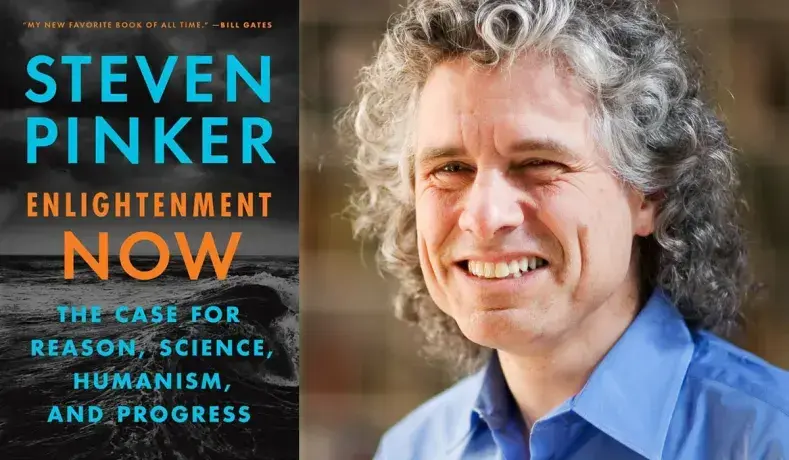
This is Part IV of a series of blog posts on Steven Pinker and his book Enlightenment Now: The Case for Reason, Science, Humanism, and Progress. Read: Part I, Part II, Part III.
There is no need for God. Instead, humanism is sufficient. What is humanism according to Pinker? “There is a growing movement called Humanism, which promotes a non-supernatural basis for meaning and ethics: good without God.” 410] Further, “The goal of maximizing human flourishing—life, health, happiness, freedom, knowledge, love, richness of experience—may be called humanism.” [410]
Pinker argues that theistic morality has two fatal flaws. First, “there is no good reason to believe that God exists.” [421] Further, “Whatever we make of the hard problem of consciousness, positing an immaterial soul is of no help at all.” [428]
Second, God “cannot be the source of morality” [428]. Pinker argues that believers cherry-pick the palatable human injunctions while allegorizing, spin-doctoring, or ignoring the vicious ones. In fact, he says, believers read the Bible through the lens of Enlightenment humanism.” [429] So, God is not a good starting point.
Instead, Pinker believes humanism provides the answers. His position: “A humanistic morality rests on the universal bedrock of reason and human interests: it’s an inescapable feature of the human condition that we’re all better off if we help each other and refrain from hurting each other.” [429] In other words, why can't we all just get along! Few sophisticated people believe such poppycock; it’s about the laws of power (see Robert Greene's The 48 Laws of Power and The Laws of Human Nature).
Pinker says: “Few sophisticated people today profess a belief in heaven and hell, the literal truth of the Bible, or a God who flouts the laws of physics.” [430] As a side note, it is interesting that he relies on validation of his arguments by things such as smart people don’t believe it; so that would mean that if we found some smart people who believe in certain things then that argument would be valid.
To buttress the validity of his argument, he states that “…the world’s fastest-growing religion is no religion at all.” [435] Not true. Pinker likes stats and graphics and draws conclusions from them. So, let's look at the Church of Humanism. Yes, there is such a thing. It is a fringe and shriveling group, which most people would view with the same credibility as the Flat Earth Society.
Again, Pinker’s common theme: if you were smarter, you wouldn’t believe this God stuff! Why? “…when people become more intellectually curious and scientifically literate, they stop believing in miracles” and the supernatural [438] Again, not true, unless you are drinking the Kool-Aid. For example, many mainstream non-religious books reflect elements of faith and spirituality, from leadership guru Robin Sharma to the actor Anthony Hopkins.
Many of Pinker's arguments in the book are shallow, bordering on laughable. One howler, in homage to his Canadian roots, is when Pinker states that the value of humanism is reflected in the fact that Canada is among the nicest places to live! [438] He’s been away too long. Despite their happiness, “medical assistance in dying” (MAiD) is allowing Canadians to engage in state-assisted suicide in record numbers.
Another howler is his blanket statement about the German church's support for Hitler. As is well-known, the church was bullied into compliance with Hitler or face dire consequences. There was resistance. The church included people such as Dietrich Bonhoeffer, who offered resistance and paid for it with their lives.
PInker argues that the more religious the state, the more dysfunctional its citizens’ lives [439]. He apparently is not aware of the role of Christians in starting social service institutions.
You need a lot of faith to believe in a Pinker world – the generalizations regarding evolutionary biology and other matters are big enough for a herd of Mastodons to stampede through. The positive qualities of people are there because of evolutionary values. He closes with a pathetic plea, trying to provide a stirring call to action.
Many of his criticisms of the church and faith are, at the core, valid, and it would be foolhardy to deny it, but he stretches his point. Pinker argues that “….the absurdity of seeking a foundation for morality in the institutions that brought us the Crusades, the Inquisition, the witch hunts, and the European wars of religion.” [450] And secularism brought us Stalin, Hitler, and the Holocaust
The more you criticize, the more you deflect from the weakness of your own arguments. He doesn’t use his own logic and goes against his own arguments. He tries to counter the argument that humans are predisposed to religion or that there is a God-shaped vacuum inside of us. He says “vulnerability is not the same as a need” [451]. In other words, people may be vulnerable to religion, but they do not need it.
Denmark and New Zealand are examples of secular societies that do well [451]. “The bounty of a cosmopolitan secular democracy is there for everyone to see.” [452] Wow, what an example to prove a point! Denmark?
Pinker concludes: “We are born into a pitiless universe, facing steep odds against life-enabling order and in constant jeopardy of falling apart. We were shaped by a ruthlessly competitive force. We are made from crooked timber, vulnerable to illusions, self-centeredness, and at times astounding stupidity.” [452]
The case for Enlightenment Now “may be cast as a stirring narrative [452], but there is no limit to the betterments we can attain if we continue to apply knowledge to enhance human flourishing.” [453]
The mainstream isn’t drinking the Kool-Aid as his Ivory Tower musings don’t jive with people’s lived experiences. If Pinker is the best apologist for humanists, then religion and spirituality will keep growing. If he is the best reflection of reason, when he is littered with biases and apparently emotion-riddled petty slights and put-downs, then he is undermining his own case.
As John Lennox said to Richard Dawkins in one of their debates, “Richard, you have nothing to offer me.” That’s the bottom line. A humanist view is not appealing to most people, given the alternatives. It fails as a philosophy of life--it only resonate if you are drinking the Kool-Aid.