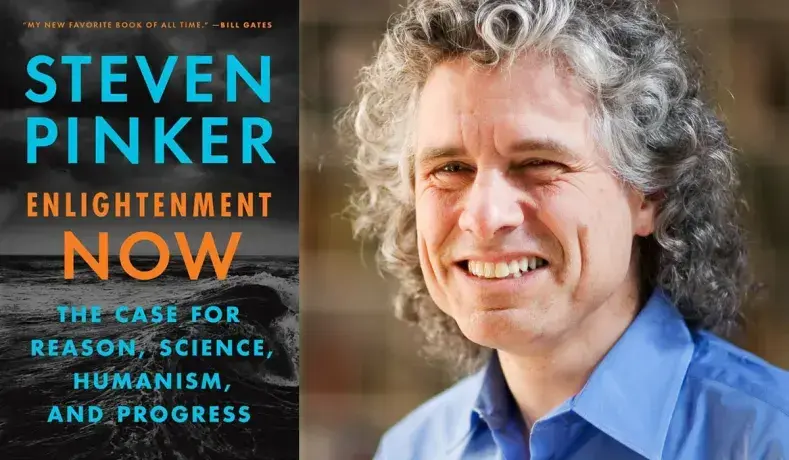
This is Part III of a series of blog posts on Steven Pinker and his book Enlightenment Now: The Case for Reason, Science, Humanism, and Progress. Read: Part I, Part II, Part IV
What does Pinker think about happiness and meaning? He notes that people’s happiness is determined by how well they think they are doing relative to their compatriots [263]. The level of happiness in a country is correlated with the level of freedom; also, people single out freedom as a component of a meaningful life, whether or not it leads to a happy life [265]
One dimension of a good life is meaning and purpose [267]. He helpfully points out the interesting difference between happiness and meaning. Things might make us unhappy in the short term but are meaningful in the long term, like raising kids [267]
He cites research with the results that: “many of the things that make people happy also make their lives meaningful, such as being connected to others, feeling productive, and not being alone or bored.” [267] That doesn't seem like an onramp to leading a significant life. Further, Pinker explains that “there is plenty of unhappiness that can be reduced, and no limit as to how meaningful our lives can become.” [268] A humanist war cry of "we shall overcome."
With respect to humanist progress, PInker proclaims “…we know that richer people within a country are happier, that richer countries are happier, and that people get happier as their countries get richer (which means that people get happier over time)” [270-1]. That’s an assertion that’s hard to sustain, especially on a global scale, and which has massive implications.
PInker argues that overall, even if people don’t realize it, they are getting happier. For Pinker, this finding is joyful: “This increase in happiness is yet another indicator of human progress.” [270] Again, from the ivory tower, it's all good.
Even social media is good. Pinker asked, circa 2018 when Enlightenment Now was published, whether young people are becoming addicted to digital crack cocaine. Why is that bad? Pinker argued with respect to loneliness, “the data show it is false: there is no loneliness epidemic.” [274] Pinker reveals that “Users of social media have more close friends, express more trust in people, feel more supported, and are more politically involved.” [276] It’s all good. Jonathan Haidt's The Anxious Generation hadn’t been written when Enlightenment Now was published, so we didn’t know at that time how wrong Pinker could be.
Pinker is often in a Pollyannish overdrive, saying things with such enthusiasm he may actually believe them: “Everything is amazing. Are we really so unhappy? Mostly, we are not. Developed countries are actually pretty happy, a majority of all countries have gotten happier, and as long as countries get wealthier, they should be happier still.” [283]
How does “spirituality” fit in with meaning and happiness? According to Pinker, if it is just awe and beauty, that’s fine. But not if it is something more and the conviction that the universe is somehow personal, that everything happens for a reason, that meaning is to be found in the happenstances of life.” [434]
Pinker's view is that a “spirituality” that sees cosmic meaning in the whims of fortune is not wise but foolish. The first step towards wisdom is the realization that the laws of the universe don’t care about you. The next realization is that this does not imply that life is meaningless, because people care about you and you care about them. You care about yourself, and you have a responsibility to respect the laws of the universe that keep you alive, so you don’t squander your existence.” [434-5] Welcome to the Church of Humanism. Yes, there is one. You likely haven't heard of it. It's as popular as The Flat Earth Society and growing at the same rate.